
The world of guitar effects pedals is vast and diverse, offering a seemingly infinite array of tonal possibilities for musicians to explore. From creating atmospheric soundscapes to adding that extra punch to your riffs, these compact devices can drastically change your sound with just a stomp of your foot.
In this article, we’ll delve into the essential types of guitar pedals, providing an overview of their characteristics and uses. We’ll start by categorizing the various types of effects pedals, and then we’ll analyze the function of pedals in each category. From distortion and overdrive to modulation and time-based effects, we’ll help you navigate the colorful landscape of stompboxes and unlock new creative avenues for your playing.
Guitar effects pedals fall into the following categories:
A. Gain/Overdrive
- Clean boost
- Treble boost (also fits into Equalizers)
- Preamp
- Overdrive
B. Distortion/Overdrive
- Distortion
- Fuzz
- Overdrive
C. Dynamics
- Compressor
- Sustainer
- Noise gate
- Noise suppressor
D. Equalizer
- Graphic EQ
- Semi-parametric EQ
- Filter
- Treble boost (also fits into Gain category)
- Enhancer/exciter
E. Modulation
- Chorus
- Phaser
- Flanger
- Pitch shift
- Octave divider
- Rotary simulator
- Tremolo/vibrato
- Ring modulators
- Wah pedal
- Harmonizer
- Talk box
F. Time-based
- Echo
- Delay
- Reverb
- Loopers
Understanding the Main Guitar Effects Pedal Categories
Gain Changers
As recording engineer and educator Tom Lubin (Electric Ladyland Studios) once said, “There are two types of distortion: the kind you like, and the kind you don’t.” We’re going to talk about the kind we like.
Originally, distortion came from overdriving preamps, power amps, output transformers, and speakers. Overdrive is boosting gain until a waveform clips. Clipping is when the peaks and valleys of a signal exceed the available headroom of a system and the tops of the waveform flatten, hence the term, “clipping,” since the waveform looks like the top has been cut off or clipped (like a military buzz cut). Distortion also came from other physical sources such as torn speakers and loose tubes.
You may have noticed in the list above that overdrive pedals appear in two main categories, Gain and Distortion. The reason for this is that overdrive and distortion pedals create distortion with transistors emulating the sound of overdriven tube amps, rather than overdriving the amp itself. As a result, distortion and fuzz pedals don’t produce significant changes in level. If fact, rather than gain-changing pedals, they could be considered modulation pedals (more on that later), since they alter signal without boosting gain.
How Distortion Pedals Work
We mentioned above about a waveform exceeding the headroom of a device and resultant clipping. If you send a guitar signal into a distortion pedal, there’s really no possibility of overdriving the pedal, since the guitar output is a low-level signal.
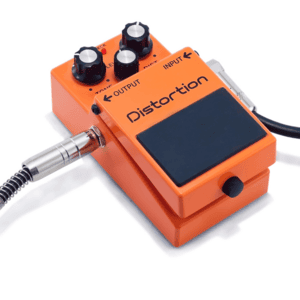
So, how does a distortion pedal create the effect of clipping?
Simply by splitting and then combining two signals that are in phase. The second signal is a low-amplitude, high frequency signal that’s combined with the unaltered signal. As the signals are combined, the amplitude of the combined waveform exceeds the headroom of the pedal, which flattens the peaks and changing the shape of the waveform to resemble various types of tube amplifier distortion.
If you look at the definition of modulation, which is one signal altering another, you can see why we said that distortion pedals could be categorized under modulation. That said, you might place a distortion pedal almost anywhere in the signal chain, but experience tells us that they sound best when acting on the full-range signal of the guitar. However, if you were in a rebel-without-a-cause kind of mood, you could place distortion pedal after a chorus pedal, for example, and see if you like the sound of distorted chorus.
How Overdrive Pedals Work
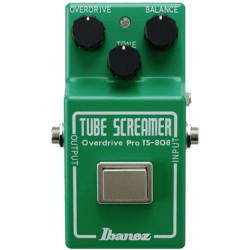
An overdrive pedal is designed to duplicate the effects of overdriving a guitar amp by increasing input gain. In the case of overdrive, distortion occurs when playing harder, while softer playing keeps the signal clean. An overdrive pedal works the same way a distortion pedal does, but with softer clipping, which in turn maintains the original timbre of the instrument. This is why you want to put overdrive first in your signal chain.
Fuzz pedals, like the ones made popular by Jimi Hendrix, use an adjustable frequency multiplier to add extra harmonic overtones. This creates a rounder, warmer distortion.
Fuzz pedals can also be considered modulation